
One searches for “best CA near me”, “home loan consultant”, or “book a free skin consultation”. Within no time, your business pops up on the first page of the search results. The person clicks on the ad, goes through your services, fills in the contact form, and converts into a potential client. This is how Google Ads for lead generation works for businesses.
While other marketing channels take time to show valid results, Google does it in the same second a user searches for it.
However, getting clicks on ads is half of the process. To turn those mere clicks into qualified leads requires the right inbound marketing lead generation.
From choosing the right keywords and campaign types to optimising the landing page, tracking, and attributing every lead properly, all contribute to optimising the PPC lead funnel.
Here in this guide, we will explore the practical ways to use Google Ads for lead generation in 2026. It will help you attract high-quality leads, make your advertising budget clear, and grow your business with confidence.
What Makes Google Ads A Powerful Lead Generation Tool
One of the most important aspects of running a B2B or B2C business is lead generation. Attracting the right audience, however, can prove to be a difficult task for many businesses. This is why Google Ads for lead generation is particularly beneficial to any business.
- Connect with the right audience – Unlike the general promotion of your business to any user, it allows you to connect with those who are searching for something like what your business offers.
- Potential to convert – The users you target through this form of advertising already have a demand for something similar and therefore are more likely to become customers.
- Controls in your hand – The ability to control how and when your ads will be viewed is another reason that makes Google Ads particularly appealing for businesses.
- Precise Targeting – Targeting your ads by specific keywords, locations, languages, devices, and interests ensures that your budget will be invested in the users who are more likely to convert into leads.
- Easy Reporting – Google Ads offers insights into your campaigns, which can help you track and analyse the results and make smart decisions.
By tracking the conversions, trying out different types of ads, and making use of AI-based optimisation tools, you can enhance the quality of company leads. If you own a local business or even a rapidly growing company, Google Ads lead generation campaigns can bring you success if managed strategically.
How to Plan a Google Ads Strategy For Lead Generation Before Running Ads
Before running your lead generation Google Ads campaign, make sure to craft a roadmap that will be consistent with your business objectives. Planning a Google Ads lead gen strategy can enhance the quality of leads, help to avoid spending money on non-targeted ads, and increase the likelihood of converting visitors into customers.
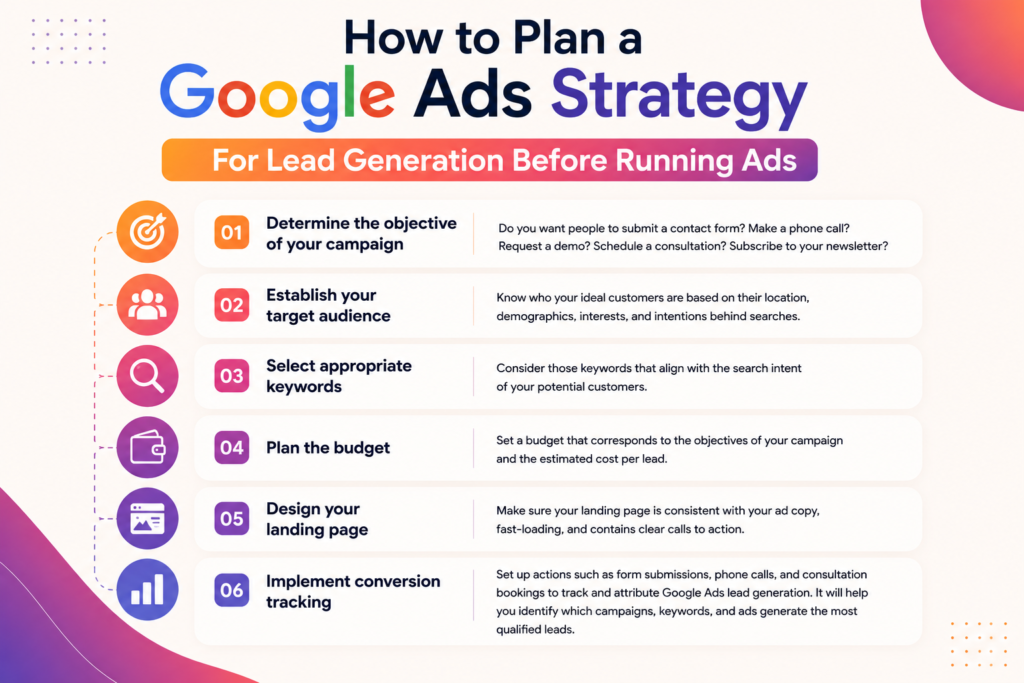
- Determine the objective of your campaign: Do you want people to submit a contact form? Make a phone call? Request a demo? Schedule a consultation? Subscribe to your newsletter?
- Establish your target audience: Know who your ideal customers are based on their location, demographics, interests, and intentions behind searches.
- Select appropriate keywords: Consider those keywords that align with the search intent of your potential customers.
- Plan the budget: Set a budget that corresponds to the objectives of your campaign and the estimated cost per lead.
- Design your landing page: Make sure your landing page is consistent with your ad copy, fast-loading, and contains clear calls to action.
- Implement conversion tracking: Set up actions such as form submissions, phone calls, and consultation bookings to track and attribute Google Ads lead generation. It will help you identify which campaigns, keywords, and ads generate the most qualified leads.
7 Ways To Use Google Ads For Lead Generation
Google Ads campaigns help you generate leads by collecting information through a form fill, phone call, or booked demo. Thus, here are some proven Google Ads strategies for lead generation essential to your campaign’s success.
1] High-Intent Keywords
The effectiveness of your Google Ads lead generation campaign mostly depends on the choice of keywords. High-intent keywords are search queries made by users ready to act, meaning they want to get in touch with a company, book a service, make a purchase, or ask for a quotation.
Using high-intent keywords is one of the best ways to generate high-quality leads rather than boost traffic.
- Select keywords with purchasing intent: You can use queries such as “xyz expert near me”, “book a free consultation”, or “best interior designer in India”.
- Use long-tail keywords: Specific search queries always give you better results in terms of visitors’ relevancy and also feature low competition.
- Apply location-based keywords: In case you serve a specific city or region, include its name in your keywords list in order to target the local audience.
- Find negative keywords: Filter out irrelevant search queries to prevent your ads from showing up in front of the wrong audience.
- Check keyword performance: Monitor which keywords generate the most qualified leads and update your keyword list accordingly.
2] Choose the Right Campaign Goal For Google Ads Lead Generation
The success of your lead generation with Google Ads highly depends on the type of campaign you choose to advertise. Each Google Ads lead generation campaign has a distinct objective, and therefore, using the appropriate type could help you reach the right people.
A) Search campaign
These are the most effective options for organisations looking to attract high-intent audiences. The ads display when individuals search for the kind of service or product offered by your organisation, and they are perfect for lead generation.
B) Performance Max campaigns
Google PMax can be used if you want to reach your potential customers via Google Search, YouTube, Gmail, Display, Discover, and Maps. This product takes advantage of Google’s AI technology to run ads in the places where it would work best.
C) Display campaigns
Display advertising shows up on websites, apps, and even YouTube. While display ads aren’t always the ideal medium for generating leads directly, they work well for branding and reaching out to people who have previously visited your website.
If you are just beginning with your campaign, you can go for search ads. With time, when enough data on conversions is collected and the number of campaigns increases, you can go for Performance Max campaigns and display campaigns to generate more quality leads.
3] Create Creative Ad Copies That Get More Clicks And Leads
An ad represents the first point of contact that a user will likely have when searching for services from a business like yours. Hence, it needs to create a good impression that would encourage the user to click on the ad and not that of your competitors.
Your Google Ads lead generation campaign should resolve the customer’s problem and not forcefully promote your business. Thus, make sure that your ad copy is simple and relevant to the targeted keywords and fulfils the user’s query.
Whether it’s a free consultation, same-day service, professional assistance, competitive pricing, or other features, concentrate on covering the advantages you can provide your users. Also, make practice to end your ads with a strong call to action, such as “Get a Free Quote”, “Book a Demo”, or “Buy Now”.
4] Direct Visitors To A High-Converting Landing Page
The importance of landing pages cannot be underestimated within the context of a Google Ads campaign. Even though the campaign itself may be successful, poor performance of the landing page could make your efforts fruitless.
Here is what elements a high-converting PPC landing page must have.
- A good headline that aligns with the content of your Google Ads.
- Simplicity of the form for getting in touch without unnecessary questions.
- The appropriate call-to-action, such as “Get a Free Quote” or “Book a Free Consultation”.
- Positive testimonials, ratings, certificates, etc., increase trust in your brand.
- Fast loading speed of the landing page for mobile devices, with the opportunity to easily fill out the form.
Such a combination of Google Ads and a landing page is important to transform website visitors into potential leads.
5] Use Smart Bidding And Native AI Tools To Improve Quality Leads
Using Google Ads for lead generation is not only about making users click on the ads. The process of lead generation requires attracting in-market people who have an interest in the products or services you are offering. In this case, smart bidding, AI Adviser, and rule-based settings can be helpful.
- Smart Bidding provides an opportunity for automatically adjusting the bids based on search intent, location, device used, browsing behaviour, and likelihood to perform actions.
- With the help of Google Ads’ native AI tools, it becomes possible to gather data regarding what type of people may become leads.
- Rule-based automation can enable the system to adjust the bids so that people having a greater chance of filling in a form, making a request for a quote, arranging an appointment, or just calling the business will be targeted.
Thus, the process to get leads with Google Ads can be optimised and automated for targeting those people who are more likely to convert than just visiting the site. Proper utilisation of smart bidding and AI can contribute to improving lead generation with Google Ads. This approach can also help you save money on ad spend and CRO.
6] Track Google Lead Generation Ads Attributes
It is crucial to track your results if you want to optimise your ongoing Google Ads lead generation. With this approach, you will know which campaigns, keywords, and ads help you produce high-quality leads.
- Set up conversion tracking: Follow the user’s actions such as filling out forms, calling you, making an appointment, or requesting a quotation.
- Use Google Ads with Google Analytics: Collect detailed information about user behaviour after the ad click, including visited pages and performed actions.
- Find the most successful campaigns: Analyse the campaigns’ results to identify the best ads, keywords, and landing pages producing high-quality leads.
- Optimise your budget using the data: Use the data collected to make improvements in your campaigns and save ad money.
7] Use Remarketing Campaign
The majority of individuals do not leave their details during their initial visit. They might be weighing the pros and cons of various enterprises or just need some time to make a choice. Remarketing is going to help you remain in touch with these potential customers and give them yet another motive to come back.
- Create a separate audience list for your remarketing campaign based on their activity. It may include users visiting a particular service page, clicking a CTA, or abandoning the site without filling out a contact form.
- Use customised messages in your ads by mentioning the particular service the visitor has seen.
- Add elements that will build trust in potential clients, like your awards, years of experience in this field, positive feedback from previous clients, or a free consultation.
- Keep refreshing your creatives because people do not like to see the same old ads.
- Use the appropriate ad frequency cap to not annoy your potential customers.
- Analyse Google Ads remarketing CPC and conversions to define the best-performing audiences for lead generation.
Common Google Ads Mistakes That Can Affect Your Lead Quality
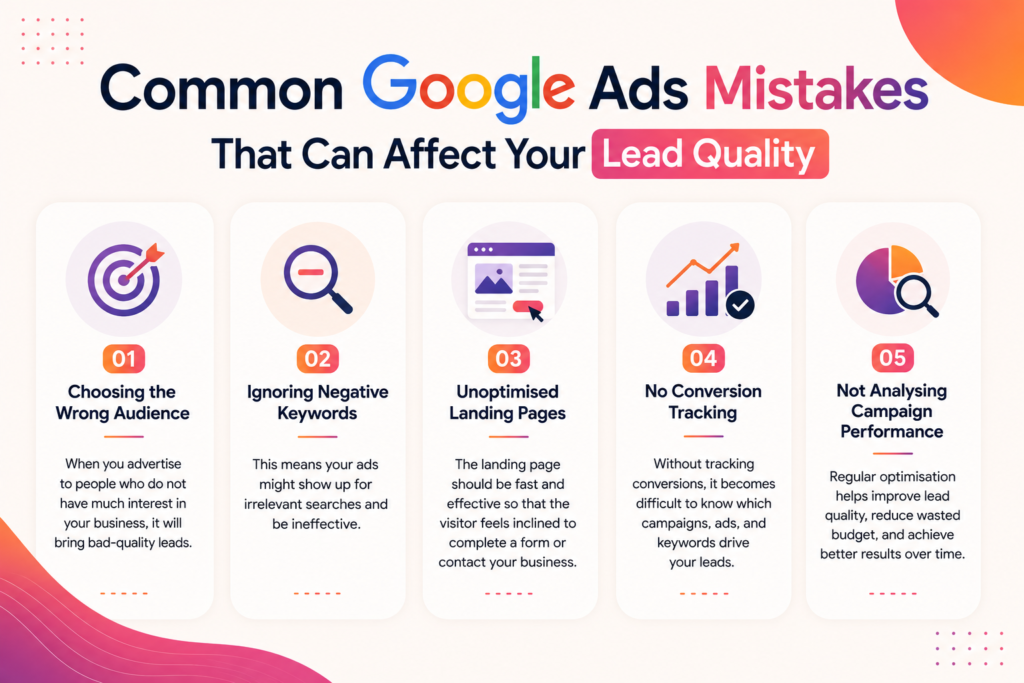
Choosing the Wrong Audience – When you advertise to people who do not have much interest in your business, it will bring bad-quality leads.
Ignoring Negative Keywords – This means your ads might show up for irrelevant searches and be ineffective.
Unoptimised Landing Pages – The landing page should be fast and effective so that the visitor feels inclined to complete a form or contact your business.
No Conversion Tracking – Without tracking conversions, it becomes difficult to know which campaigns, ads, and keywords drive your leads.
Not Analysing Campaign Performance – regular optimisation helps improve lead quality, reduce wasted budget, and achieve better results over time.
Conclusion – Get Qualified Leads with Professional Support
To make sure that a Google Ads lead generation campaign is successful, it requires doing more than just placing ads. Selecting suitable keywords, reaching out to the target audience, developing relevant ads, creating optimised landing pages, and monitoring conversion rate all help to ensure that the lead generation process goes well.
Further, by following a data-driven Google Ads strategy for lead generation and optimising your campaigns accordingly, you can improve lead quality, reduce wasted ad spend, and achieve better results.
If you still struggle to get enough leads, you must contact a result-driven Google Ads lead gen agency. You can even claim a free Google Ads account audit performed by our experienced team at Digital Narada.