
Why Meta Ads lead generation fails in India
Vikram runs a fintech startup in Hyderabad. On paper, his Meta Ads account looks healthy: 340 leads in a month at Rs. 210 each.
Then his sales team starts dialling. They get through to maybe 60 people. Twelve sound mildly interested. Three actually book a demo. One, eventually, becomes a paying customer.
One sale out of 340 leads isn’t a Meta Ads problem. It’s a setup problem.
Look closer and the cracks show. The form had two fields and nothing to filter out tyre-kickers. The ad copy promised something fuzzy instead of something specific. And nobody had ever hooked up the Conversions API, so Meta was making decisions off half the picture.
We see this a lot at Digital Narada, where we run Meta Ads for B2B SaaS, D2C, real estate, education, and professional services clients. What follows are the seven things we’ve found actually separate businesses that get quality leads from Meta from businesses that just get a lot of them.
Running Google Ads alongside Meta? Our breakdown of why Google Ads get expensive and how to fix them is worth reading too, especially if you’re trying to figure out how to split budget across both.
Why Meta Ads work differently in India
A lot of Meta Ads advice floating around online was written with US or European advertisers in mind. India’s ad environment doesn’t behave the same way, and if you set up your campaigns as if it does, you’ll leave performance on the table.
Here’s what’s actually true about advertising on Meta in India right now:
- India has over 581 million Facebook users, more than any other country. Instagram’s reach here is also growing faster than in most other major markets (source: Meta Advertising India 2026)
- CPMs average Rs. 50 to Rs. 90 here, versus roughly Rs. 600 globally. CPCs run Rs. 8 to Rs. 18 against a global average closer to Rs. 140. Cheap impressions don’t automatically mean cheap qualified leads, but the cost advantage is real if you know how to use it
- A WhatsApp CTA will typically pull 5 to 10 times the response rate of a standard contact form. That’s not a quirk, it’s just how people in India, especially outside the big metros, prefer to talk to businesses
- Reels placements run Rs. 40 to Rs. 80 CPM against Rs. 120 to Rs. 200 on Feed. Same audience, 2 to 3 times cheaper reach, purely because of format
- Creative in Hindi or a regional language tends to pull 15 to 30 percent higher CTR than English-only creative once you’re outside metro audiences
- Since March 2026, Meta’s algorithm needs 50 optimisation events per ad set per week to leave the learning phase. If your budget is spread thin across a dozen small ad sets, none of them ever get there. Consolidating isn’t a nice-to-have anymore
None of this is trivia. It’s the groundwork the rest of this guide sits on. For a wider view of how Meta fits alongside other channels, see how Digital Narada approaches performance marketing.
Strategy 1: Configure instant lead forms for quality, not just volume
Instant Lead Forms are probably the most-used tool in Meta’s lead gen toolkit, and also the most commonly left on default settings.
The usual pattern: someone builds a form, keeps the two pre-filled fields Meta suggests, picks Lead Generation as the objective, and hits publish. Leads show up fast. The sales team starts calling. Half the numbers don’t pick up, and the ones that do have no idea why they’re being called.
The format isn’t the issue. The settings are.
A form with zero friction lets anyone submit with a single accidental tap, no real interest required. Ironically, the thing that makes Instant Forms convert so well (the lack of friction) is also what drags lead quality down.
Done right, Instant Forms convert at 10 to 15 percent after the click, versus 1 to 3 percent for a cold landing page (source: Involve Digital B2B Meta benchmarks 2026). The format was never the problem.
Not sure whether to use a Lead Form or a dedicated landing page for a given campaign? We cover that trade-off in Meta Ads vs Google Ads for Indian businesses.
Strategy 2: Use WhatsApp as your primary lead capture channel
If there’s one lever that’s genuinely India-specific and still under-used, it’s the Click-to-WhatsApp campaign.
WhatsApp CTAs pull 5 to 10 times the response of a form here, and it’s not hard to see why. Most Indian business owners live on WhatsApp all day. Someone who messages you there has, in effect, opted into your most personal channel by choice, so the conversation that follows feels like a conversation, not a cold call.
It works best for service businesses, higher-consideration purchases, real estate, education, and B2B, basically anywhere a conversation is a natural next step. For high-volume, low-consideration e-commerce, an Instant Form or landing page is often the more efficient route.
If you’re also building a B2B pipeline on LinkedIn, this WhatsApp play works well alongside it. Our guide on account-based marketing on LinkedIn for Indian B2B companies covers how to sequence both channels for the same buyer.
Strategy 3: Build a retargeting sequence, not a single ad
A single ad almost never converts someone who’s never heard of you. B2B buyers evaluate over weeks, sometimes months. Even a fairly simple D2C purchase involves some back and forth in the buyer’s head before they commit.
Running one ‘Book a demo’ ad at a completely cold audience and expecting conversions is a bit like walking up to a stranger at a networking event and asking them to sign a contract on the spot.
This matters even more for B2B advertisers. If LinkedIn ABM is part of your mix, our guide on how ABM on LinkedIn works for Indian companies walks through aligning retargeting across platforms.
The retargeting sequence that works in India
A structured sequence like this typically generates leads at 40 to 60 percent lower cost than prospecting alone, since retargeted audiences have already shown some interest and need less convincing.
Frequency matters here too. The average person in India sees around 48 ads a day on Meta. Cap retargeting frequency at 3 to 4 impressions per week, or you’ll turn a warm lead cold through sheer overexposure.
Strategy 4: Use Advantage+ audiences with the right guardrails
Manually stacking 15 ad sets with hyper-specific interest combinations used to be standard practice. It isn’t anymore. Advantage+ targeting now beats manual interest audiences in most scenarios, not because manual targeting was ever wrong, but because Meta’s algorithm has access to behavioural signals no human could replicate by hand.
So what does ‘with guardrails’ actually mean in practice?
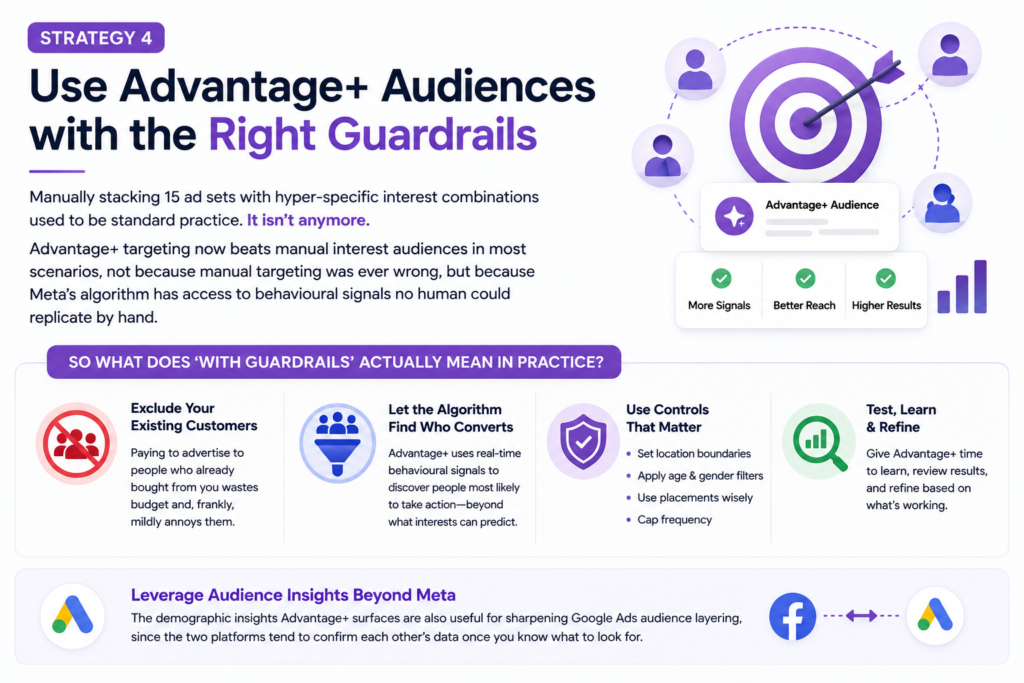
One guardrail people forget: exclude your existing customers. Paying to advertise to people who already bought from you wastes budget and, frankly, mildly annoys them.
The demographic insights Advantage+ surfaces are also useful for sharpening Google Ads audience layering, since the two platforms tend to confirm each other’s data once you know what to look for.
Strategy 5: Prioritise Reels creative above all other formats
If one creative decision moves the needle on cost efficiency more than any other for Indian advertisers right now, it’s this: make Reels your default format, not an afterthought.
Reels CPM in India runs Rs. 40 to Rs. 80, against Rs. 120 to Rs. 200 on Feed. Same audience, 2 to 3 times cheaper reach.
Which means every rupee spent buys 2 to 3 times more impressions when the creative is actually built for Reels, rather than a Feed asset awkwardly cropped to fit.
On volume: Meta’s algorithm needs somewhere between 15 and 50 active creative variants to optimise well. That doesn’t mean 50 different ideas, it means 5 to 7 core concepts tested across different hooks, CTAs, and captions. The accounts winning on Meta in India treat creative as an ongoing system, not a one-time asset drop.
If building that kind of creative volume feels like a lot to sustain, we can help build a reusable creative bank so your Meta campaigns stay fresh without burning out your team.
Strategy 6: Set up the Conversions API alongside your pixel
This is the one most Indian advertisers still haven’t done, and it’s probably costing them more than any targeting or creative mistake on this list.
The Meta Pixel only works when a browser loads your page and fires the tracking code. With iOS privacy changes, ad blockers, and browser-level tracking prevention all working against it, a meaningful chunk of your real conversions never make it back to Meta.
What that means in practice: Meta’s algorithm is optimising against an incomplete picture. It thinks fewer conversions are happening than actually are, so it bids and targets based on distorted data.
The Conversions API fixes this by sending conversion data straight from your server to Meta, skipping the browser entirely. Ad blockers, iOS restrictions, browser privacy settings, none of it matters once the data’s moving server-side.
Meta’s own figures suggest CAPI alongside the Pixel can lift attributed conversion reporting by 20 to 30 percent and bring cost per lead down 15 to 20 percent, simply because the algorithm finally has an accurate picture to work from
Digital Narada’s AI and automation service handles CAPI and CRM pipeline setup as part of onboarding, connecting your lead data back to Meta so the algorithm optimises for pipeline, not just raw form fills.
Strategy 7: Offer something valuable before asking for a lead
Across pretty much every B2B account we’ve run, the pattern holds: campaigns that lead with real value at the top of the funnel generate leads at 40 to 60 percent lower cost than campaigns that open with a straight sales pitch.
A good lead magnet isn’t a discount code or a free trial. It’s something that solves an actual, immediate problem for the prospect before they’ve spent a rupee with you. It earns trust instead of demanding a commitment upfront.
For businesses trying to connect this across channels, Digital Narada’s B2B email marketing service handles the nurture sequence that turns a lead magnet download into an actual sales conversation.
How to fix poor lead quality on Meta Ads
Back to Vikram’s campaign: 340 leads, one sale. Poor lead quality is probably the single most common complaint we hear about Meta Ads in India, and the fix is structural, not a quick tweak.
Why lead quality is poor: the root causes
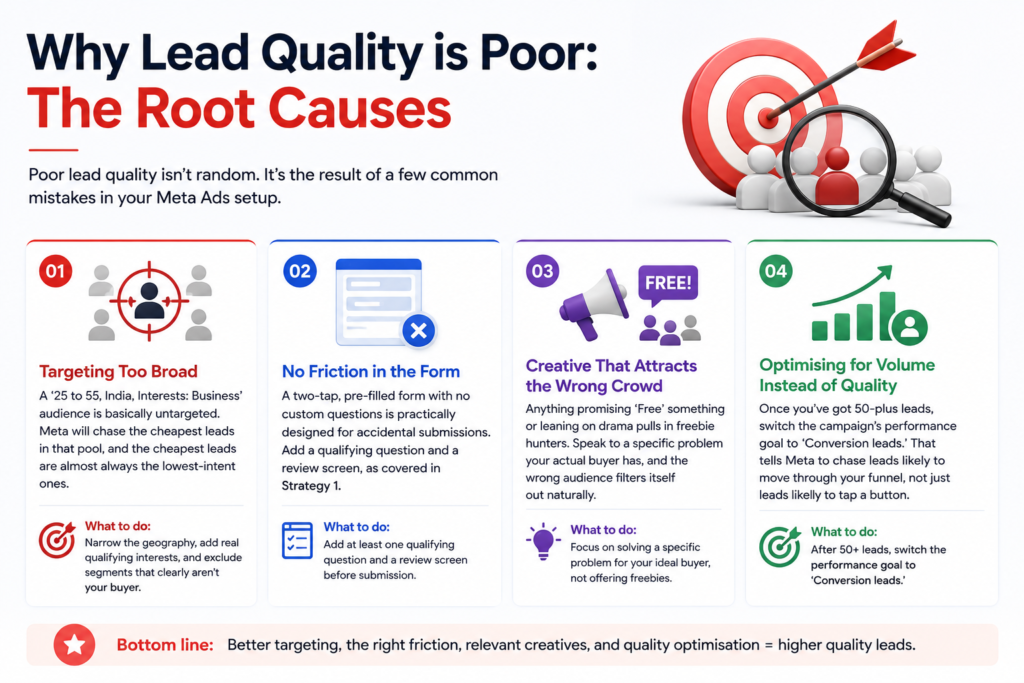
- Targeting too broad: a ’25 to 55, India, Interests: Business’ audience is basically untargeted. Meta will chase the cheapest leads in that pool, and the cheapest leads are almost always the lowest-intent ones. Narrow the geography, add real qualifying interests, and exclude segments that clearly aren’t your buyer
- No friction in the form: a two-tap, pre-filled form with no custom questions is practically designed for accidental submissions. Add a qualifying question and a review screen, as covered in Strategy 1
- Creative that attracts the wrong crowd: anything promising ‘Free’ something or leaning on drama pulls in freebie hunters. Speak to a specific problem your actual buyer has, and the wrong audience filters itself out naturally
- Optimising for volume instead of quality: once you’ve got 50-plus leads, switch the campaign’s performance goal to ‘Conversion leads.’ That tells Meta to chase leads likely to move through your funnel, not just leads likely to tap a button
FAQs
How much should Indian businesses spend on Meta Ads for lead generation?
Rs. 15,000 to Rs. 30,000 a month is a reasonable starting point for a single campaign targeting one segment. That’s enough budget for the algorithm to hit the 50 weekly optimisation events it needs to exit the learning phase. Scale up once you’ve validated your cost per lead and lead quality at that smaller spend, not before.
What is a good cost per lead for Meta Ads in India?
It varies a fair bit by industry. Rs. 150 to Rs. 400 is typical across most sectors. Education and D2C can get down to Rs. 80 to Rs. 200. Real estate, B2B SaaS, and financial services usually run Rs. 300 to Rs. 900 because of tougher competition and longer sales cycles. If your cost per lead looks unusually low, say Rs. 30 for real estate, that’s usually a sign your targeting is too broad and lead quality is suffering.
Why am I getting leads but no sales from Meta Ads?
Usually one of four things: targeting too broad, no friction in the form, creative pulling in the wrong crowd, or no structured follow-up within 24 to 48 hours of the lead coming in. None of these are platform problems, they’re strategy problems. Start with Strategy 1 and Strategy 6 for the fastest improvement.
What is the Conversions API and do I need it?
It’s a server-side integration that sends conversion data straight from your website or CRM to Meta, bypassing the tracking limitations caused by iOS privacy changes and ad blockers. If you’re running Meta Ads for lead generation in India in 2026 without it, your campaign is working off an incomplete signal. Typical impact: 20 to 30 percent better attributed conversion reporting and 15 to 20 percent lower cost per lead.
How do I improve lead quality on Meta Ads without reducing volume by too much?
Once you’ve got 50-plus leads and CRM data flowing through CAPI, switch the performance goal to ‘Conversion leads.’ Short term, cost per lead may rise. Medium term, cost per qualified lead usually drops, since you’re generating fewer low-quality leads for the same spend.
How does Meta Ads compare to Google Ads for lead generation in India?
They serve different moments in the buying journey. Google captures people already searching for a solution. Meta creates and captures interest among people who weren’t actively looking but fit your buyer profile anyway. Most Indian businesses do best running both, Meta building awareness at the top of the funnel, Google capturing the search intent that awareness creates. Our full comparison, Meta Ads vs Google Ads for Indian businesses, goes deeper into how to split budget between the two.
Start generating leads your sales team actually wants to call
India has 580 million-plus Facebook users, CPMs a fraction of what Western markets pay, and a WhatsApp-first culture that turns high-intent leads into easy, natural conversations.
The raw conditions for cheap, effective lead generation on Meta are about as good as they get anywhere in the world. What’s usually missing isn’t the platform. It’s the structure around it.
Lead forms set up for quality, not volume. WhatsApp treated as a real capture channel instead of an afterthought. A retargeting sequence that earns trust over 90 days. Advantage+ pointed in the right direction. Reels creative built for the format it’s running in. CAPI connected so the algorithm actually knows what’s working. And an offer that earns the lead instead of demanding it upfront.
Get these seven right and the leads coming in will be ones your sales team is actually glad to call. Which, honestly, is what Meta Ads was always supposed to feel like.
Want a second opinion on your current setup, or help building a lead gen campaign around these strategies from the ground up? Book a free consultation with Digital Narada. We’ll review your account, benchmark your cost per lead against your industry, and show you exactly where quality is slipping through the cracks.